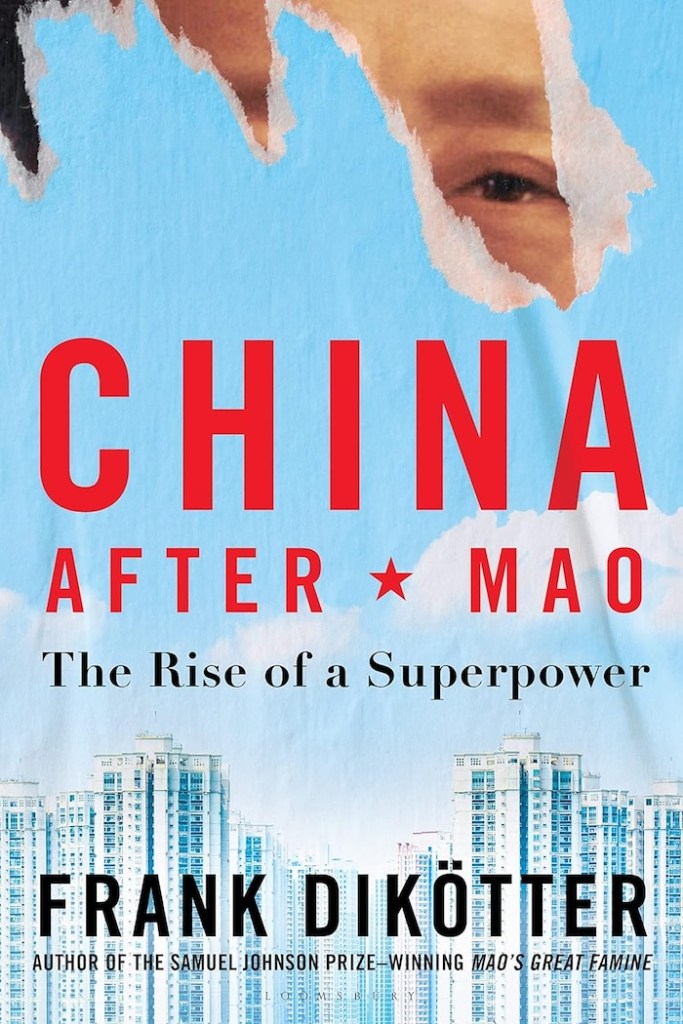
China After Mao: The Rise of a Superpower by Frank Dikotter gives us a step-by-step account of what happened to China after the death of Mao Zedong and, more crucially, how it is becoming the world’s leading superpower despite its never-ending clutches to communism rather than yielding to capitalism. I’m no stranger to the author, as I’ve read his previous trilogy, accounting Mao Zedong’s time in power. This includes The Tragedy of Liberation, Mao’s Great Famine and The Cultural Revolution. Frank Dikotter, to be honest, is what I consider to be a great researcher as well as the leading expert on this subject, along with likely being an awesome university teacher. However, his books can be pretty difficult to read, as he’s not what I’d consider a great storyteller, at least on paper.
From top to bottom, every state institution was run by a party secretary who favored other state institutions, a situation unlikely to change in the future. …under no circumstances would the private sector be allowed to grow and overtake the public sector.
Frank Dikotter – Author
As someone who is deeply fascinated with China’s past, I had to admit that I was only looking up to the Mao Zedong era. What happened afterward is usually a blur for me, so this was a great chance to learn about those events from an author I’m familiar with. As with so many things regarding China’s past, reading China After Mao can be a complete mind trip for readers not used to the idea of communism and socialism ruled with an authoritarian iron fist from the few above who wield absolute power over the entire country. Another issue I’ve noticed that might bother some readers is the frequency with which the author jumps between timelines, especially going back to the past. I did notice this happened more frequently in the first half of the book.
“Money will get the devil to grind the mill.”
Traditional Chinese proverb
While learning of China’s past is interesting, my main objective was to actually learn just exactly how China, after being absolutely ravaged during the Mao Zedong years, came to create all those modern skyscrapers and modern shopping malls that we’ve all no doubt saw or heard about in one way or another. How did a country that primarily relied on agriculture come to modernize itself against what seemed to be all odds? Was it truly a miracle, as some claim it to be, or were there some other shady happenings going on that covered the truth? Frank does a great job at explaining how this actually came to be and how China is still feeling the effects of economic policies made in the early 1990s. Time seems to move fast, and with a country of over a billion people, this seems to be no less true. In just two decades into the 21st century, a lot has happened in China. So many things have changed, and yet so many others have not. After having recently read Confessions of an Economic Hit Man, although China is obviously not without issues, were they one step ahead of the game in declining to accept U.S. debt to modernize their country and continuing to double-down on that decision along with sticking to their form of socialism regardless of how bad things got internally?
The notion that China had been humiliated at the hands of the foreigners was branded into the mind of every child and every adult.
Frank Dikotter – Author
There are likely to be many easier to read books discussing China after the Mao Zedong era and how the country is transforming itself into a global superpower that may one day take the lead from the United States. China After Mao by Frank Dikotter will present you with page after page of researched information. I would have liked for him to present more theories along with his own point of view and opinions on certain topics, just so readers like myself can put things more into perspective instead of having to absorb the non-stop input of events and stats.




 The Mindless Catalog
Leave a comment