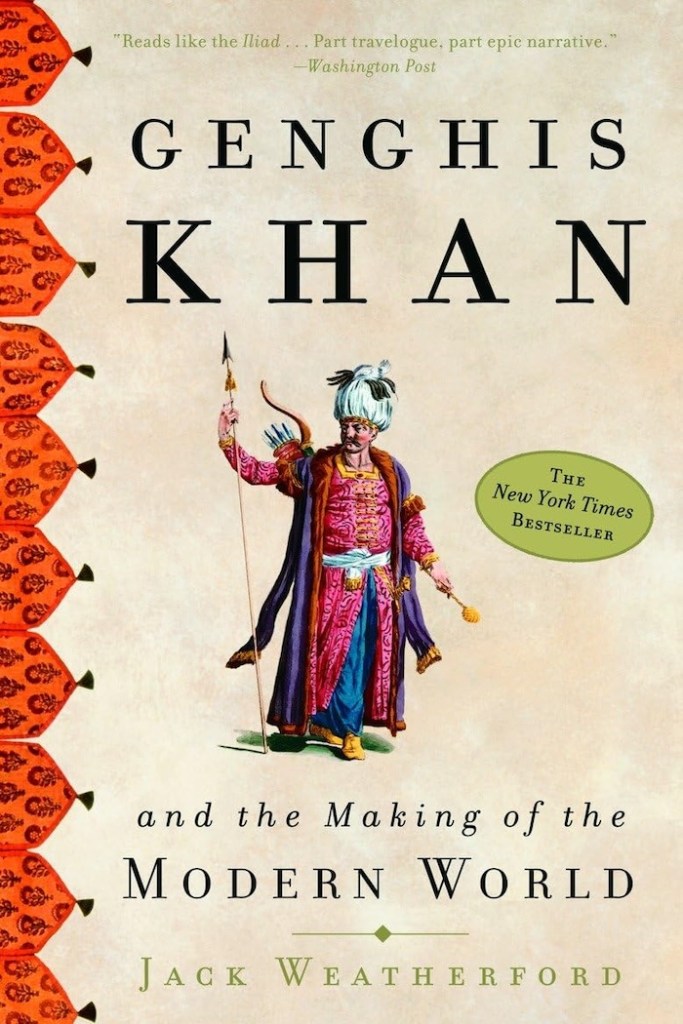
Genghis Khan and the Making of the Modern World by Jack Weatherford gives us a pretty thorough account of how a single Mongolian in the 12th century, seemingly with his back cornered against the wall, made a decision to strike back against a different tribe and from there on, actually made the modern world to what it is today. Although many in today’s modern world have likely heard of Genghis Khan, they likely aren’t aware of his and other family member’s contributions to it. This can be attributed to a reputation passed down long after his death in which the Mongols are portrayed as a group of sadistic, brutal, and uncivilized tribe hellbent on conquering as much land as possible regardless of the deaths it took to accomplish that goal. This book aims to portray a much different aspect to one of the greatest conquerors and military mastermind of all time. Although it’s obvious that conquering other nations during ancient history is a nasty business, Genghis Khan and his Mongol army is still likely being vilified as a more brutal conqueror than his earlier contemporaries. However, it’s also true that without Genghis Khan, the world we live in today likely would have looked a lot different had he not made a few key decisions in his childhood.
The Mongol armies destroyed the uniqueness of the civilizations around them by shattering the protective walls that isolated one civilization from another and by knotting the cultures together.
Author on the Mongols
To begin, the title of the book can be just a bit misleading depending on how you look at it. The majority of the book covers Genghis Kahn’s life along with his siblings rise to power along with how they govern their respective regions. It goes over some of their customs, beliefs and cultural outlook as a whole with the hope of deciphering why they were so effective in war but lacking in other areas. It also lays out why they ruled as they did after the conquering of each nation and city along their route to total domination in Europe, Russia, Persia and China. Because commerce and religion played such a huge part in the Mongols’ governance of a nation, it is here that gets the most focus in terms of how they “modernized” the world. It really isn’t until the last chapter or two that the author focuses entirely on the other changes that were brought about by the Mongols.
In twenty-five years, the Mongol army subjugated more lands and people than the Romans had conquered in four hundred years.
Author on the Mongols
The Mongols were a very smart group of people. The author will spend a great deal of time explaining how, due to their lack of superior numbers and lack of knowledge in technology, they adapted very well to the nations they captured by not upsetting the balance of things and how they controlled the flow of people belonging to certain professions all across their conquered territories to help them actually manage their hold on power instead of starting from scratch. In a weird way, the Mongols became efficient rulers, albeit for a shorter period compared to others, simply because of their lack knowledge and experience. They made up for it with their organizational skills, along with their ability to assimilate into other groups during the later stages. If there was only one book to read on the Mongols, this would be a great start for many.
*** I highly recommend the Artger channel on Youtube. They have a lot of videos on Mongolian culture, especially on cooking. Although the recipes and techniques can get repetitive at times (there’s usually a lot of meat involved!), they never fail to amaze me.
*** The TV series Marco Polo was one of the first I binged on with Netflix when it came out. It details the life and details of Kublai Khan just prior to the Yuan dynasty creation of China. Sadly, it got cancelled only after two seasons but it’s still worth a watch for those interested.
Credit to u/ChaDefinitelyFeel for suggesting this book on Reddit.




 The Mindless Catalog
Leave a comment