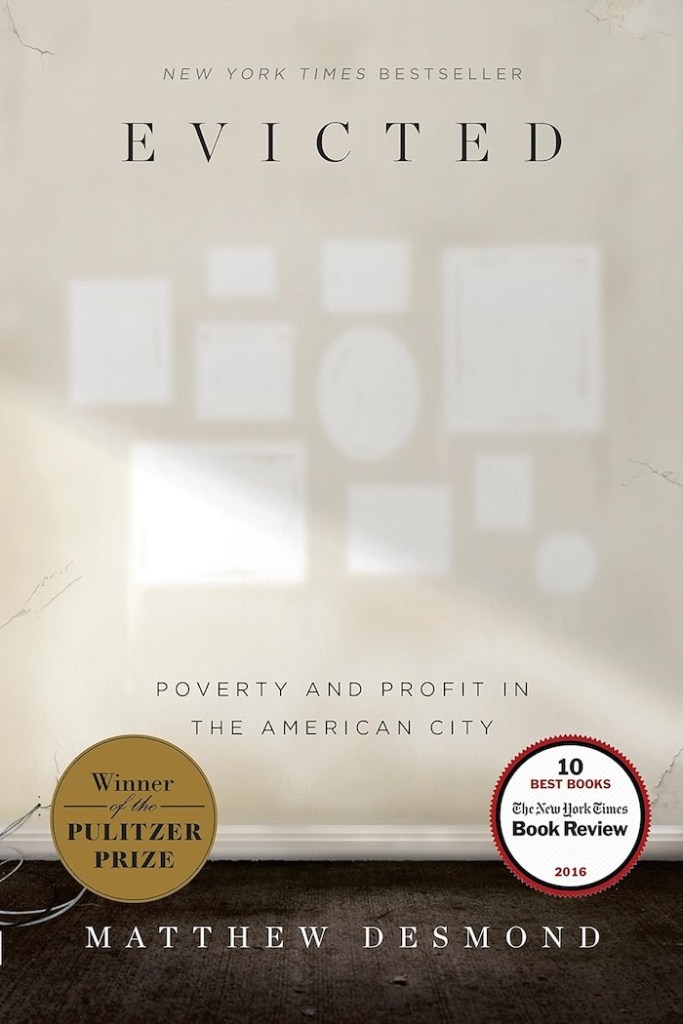
Evicted: Poverty and Profit in the American City by Matthew Desmond is a 2017 Pulitzer winner in the General Non-Fiction category, covering the problem of home eviction and homelessness within Milwaukee, Wisconsin. Although the author chooses to only cover eight or so people within this one city, his higher purpose is to generally highlight how such a big problem within the United States can be either ignored or its data so misconstrued that it doesn’t help the people at the top who actually makes the actual policy and programs to help combat homelessness and poverty see the bigger picture. Evicted takes us on a wild, yet sober journey as the author follows a group of renters and documents what they have to go through while subsisting on government assistance only, if that. Basically, these people are always one home eviction away from being completely homeless with no money and rarely with any help whatsoever.
The home is the center of life. It is a refuge from the grind of work, the pressure of school, and the menace of the streets. We say that at home, we can “be ourselves.” Everywhere else, we are someone else. At home, we remove our masks.
Author
As most would have expected, race and gender plays a critical role in the telling of this story. It was sad to learn that while African American males have a higher probability of getting incarcerated, African American females in turn are the one’s that have a higher rate of home eviction. To add insult to injury, families with children increase the likelihood of not only home eviction but are discriminated against when applying for a new home. Many factors contribute to the odds ever stacking higher for these poor families of ever breaking out of this vicious cycle. It goes to show that almost 70%-80% of a welfare check goes into rent, with obvious little leftover for other humane needs. This leads to a family being behind in rent with the landlord that will eventually end with a home eviction on their record.
“I have a right to live, and I have a right to live like I want to live. People don’t realize that even poor people get tired of the same old taste. Like, I literally hate hot dogs, but I was brought up on them. So you think, ‘When I get older, I will have steak.’ So now I’m older. And I do.”
Larraine
While it may be easy at first to simply blame the greedy, money grubbing and evil landlord, Evicted goes to show that they themselves are not without headaches. It goes to show that some type of reform is needed, as court proceedings and the eviction process would demonstrate. As a previous home renter, I can relate to the issue many in Evicted have encountered and none other than not saying anything when home repairs are needed in fear of the landlord raising rent. In the end though, as the renter, especially if they are in a badly run neighborhood, will likely lose out more in the long run. This is part of the cycle that gets repeated so often in Evicted and so frightening to see.
The poor did not crowd into slums because of cheap housing. They were there–and this was especially true of the black poor–simply because they were allowed to be.
Author
The author obviously deserves a lot of credit for putting this story together. It was great yet saddening to read his epilogue. While his idea of issuing a government backed rental voucher for all low income families is a great start, I don’t think it can be the ultimate solution. What I do agree with is that the problems raised here shouldn’t be as big an issue in the United States as it is. With other countries being able to take care of the “home” problem for their citizens much better than the United States, it seems no different from when it comes to the issue of healthcare as well. The United States is only kicking the can down the road and, as the author demonstrates, will have a huge impact on future generations.
Credit to u/sqmcg for suggesting this book on Reddit.




 The Mindless Catalog
Leave a comment