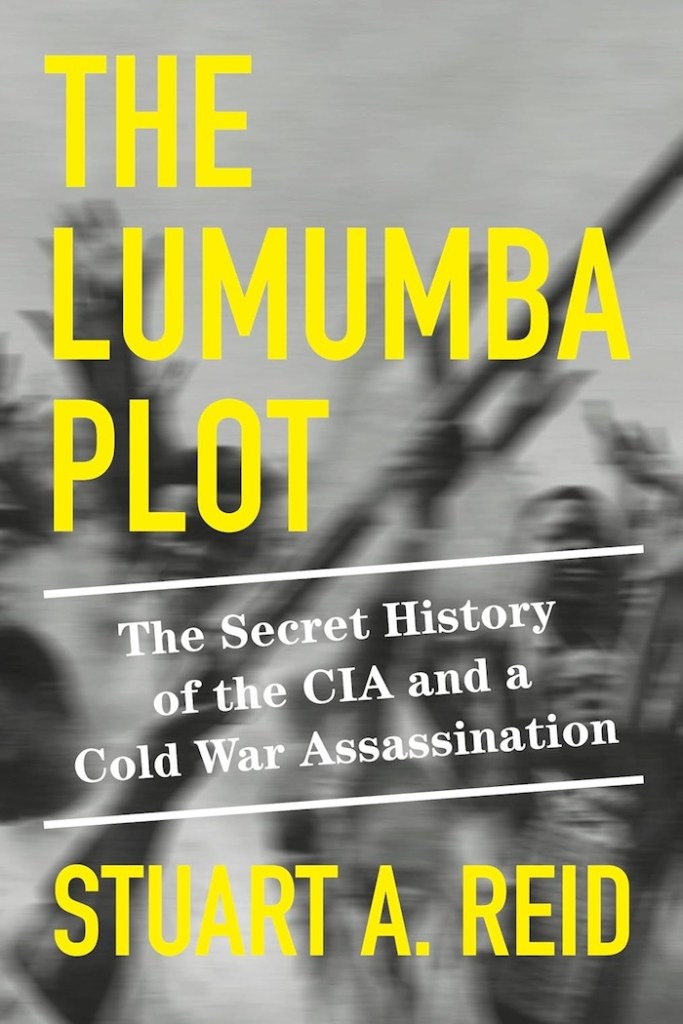
The Lumumba Plot: The Secret History of the CIA and a Cold War Assassination by Stuart A. Reid goes over one of the first documented evidence of an assassination attempt at the highest level of the United States government against a foreign politician during the Congo’s fight for independence in the 1960s. What a story we got here, folks! I first got a whiff of this incredible plot while reading Confessions of an Economic Hit Man. Coming across this book on this specific subject, it quickly piqued my interest to learn more about Congo fought for its independence, along with how and why the United States was so interested in this region. A combination of fear, uncertainty and doubt along with prejudices, racism, paternalism all played into the plot of the newly formed CIA along with the President of the United States issuing the green light to assassinate Patrice Lumumba.
“We want democracy, the sort of genuine democracy we see here in the United States, for instance, where every sort of philosophy is respected, where the dignity and the rights of each and all are respected.”
Patrice Lumumba
As a journalist for The Foreign Affairs, of which I occasionally read from time to time for long form journalism on foreign policy and opinions, I knew I’d be getting as concise a story as possible on a thoroughly researched subject along with hopefully as little bias as possible. The story of Patrice Lumumba, from childhood to becoming prime minister of a united Africa, is the stuff that could only be made from legends. His attitude along with perseverance to fight through whatever challenges that awaited him is what made him a national hero. But as the story goes to show, nothing is always as easy as it seems, especially where politics both foreign and domestic is concerned.
“…for without justice there is no dignity and without independence there are no free men.”
Dag Hammarskjöld
The story of Lumumba’s rise and demise also spends a lot of attention on the United Nation’s early days. Caught in the middle of a tense situation in which remaining neutral seems all but impossible, it once again goes to show how politics and money played such a huge influence on how the way things played out. Sure enough, the United States growing fears of a communist takeover of the Congo by the Soviet Union also altered the playing and helped tipped the balance of power between Lumumba, seen as radical, unpredictable and already under the influence of the Soviets, against his enemies. But the story goes to show that while Lumumba was definitely not without faults, the quick dismissal of him by the United States’ highest level of government based on biased reporting by diplomats on the ground seemed a bit premature once they had time to review the events years later.
“Glory to the our freedom fighters! Long live independence and African unity. Long live the independent and sovereign Congo!”
Patrice Lumumba
Coincidentally, I had put the movie Hammarskjöld: Fight for Peace, on my to-watch list prior to reading this book. Having no idea who he was at the time, I was quite shocked to learn of how he played such a central role in the conflict within the Congo. The other movie to watch would be “Lumumba” starring Eriq Ebouaney from 2002. I have a feeling if a remake is to be made, either Jamie Foxx, Will Smith or Anthony Mackie would ace the role of playing Patrice Lumumba.
 The Mindless Catalog
Leave a comment