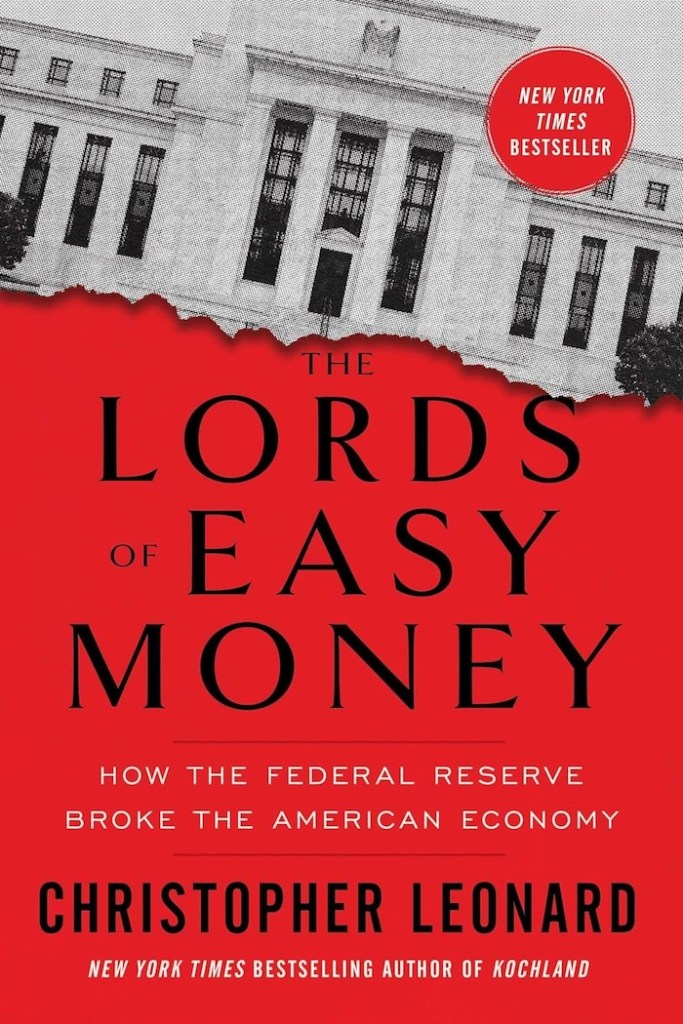
The Lords of Easy Money: How the Federal Reserve Broke the American Economy by Christopher Leonard goes in-depth about how one of the America’s central bank, with once having limited powers, has slowly over the decades extended their reach via monetary policies to affect pretty much everyone in the country for better or worst. It’s a complex subject, but the author presented the story in such a way that it skipped a lot of the mundane information and instead gave us average readers a much clearer understanding of just what exactly the Federal Reserve is and how manipulating what would seem like a very simple number called the interest rate can have such a wide-reaching impact not just in the United States but everywhere in the world as well. It also slowly presents its case, chapter by chapter, and depending on your lenses, on how it literally is widening the wealth gap between the have’s and the have not’s in our society.
The most boring-seeming companies in America became financial engineers, borrowing cash, buying their own stock, pumping up their share price, and often justifying higher pay packages for their executives….What mattered more was access to debt markets and rising share prices.
Author
I swear that if in my high school days that I was made to learn more about these interesting topics, I may very well have gotten a job in finance. One of the most fascinating things that I’m sure many will learn and be shocked to have learned is how indebted many companies are. We were likely taught from an early age that debt is a bad thing and having too much of it will be disastrous. Well, if that’s truly the case, then I want to know why and how exactly is it that companies with such a huge debt on their balance sheet can still pay their CEO’s and top executives millions and millions of dollars in bonuses. The Lords of Easy Money will show that while many of us normal people tend to believe that injecting more money into our financial system can only be seen as a positive event, the reverse is usually true. It usually benefits the people that already have money, a lot of money, to begin with.
“I see considerable risk in conducting policy with the consequence of transferring income from the poor, those most dependent on fixed income, and the saver to the rich.”
Richard Fisher – President of the Federal Reserve Bank of Dallas
There is so much to unpack with this book. At the heart of things, we’ll get to learn how the Federal Reserve is oddly structured along with how they not only created financial problems in the first place but also how they were the fixers as well. For example, I loved how it shows that while the Federal Reserve kept pushing for low interest rates along with a slick monetary policy called quantitative easing, it was basically forcing the big money players along with retailers to invest their money in riskier assets. Once that eventually blew up, it goes to show how it propped it up again by injecting even more money into the system. It’s almost becoming a never ending cycle and dangerous to boost. All that plus so much more is discussed in detail within the book, and the best part is you don’t really have to be a financial geek to understand it. Well, for the most part anyway.
“Age-old behaviors, such as greed, shortsightedness, and arrogance, are at the center of these problems, and, I would caution, they are with us today just as they were in the 1980s.”
Thomas Hoenig – President of the Federal Reserve Bank of Kansas City
If you’ve ever zoomed out of a chart on your favorite stock or ETF, you’ll likely have seen the huge dip in the middle of March of 2020, which was right in the beginning of the Coronavirus pandemic. The market fell off a cliff. But then something miraculous happened. It quickly rebounded in the few months afterward. But was it really a miracle? It’s these events that when you learn about it afterward that really gives you a perspective of just how crazy our financial system has become. The very day I finished this book our stock market took a nasty rout. While many new investors obviously panic, seasoned investors likely aren’t. They know that the Federal Reserve will likely have to step in and bail it out if things get too crazy. Is that good or bad? Well, it’s good if you already own assets and bad if you don’t. Either way, this goes to show that our financial and economic system is operating a lot differently than in previous decades. But one thing seems sure. The money printer will continue to go brrrrrrrr!!!!!!!



 The Mindless Catalog
Leave a comment