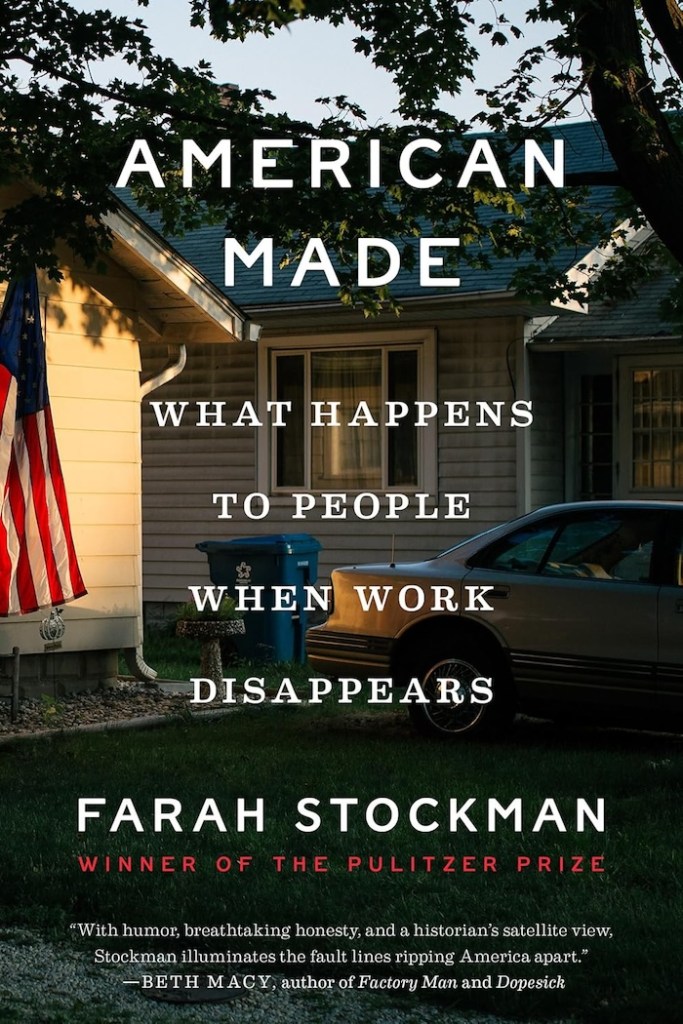
American Made: What Happens to People When Work Disappears by Farah Stockman follows the lives of three steel plant workers at the Rexnord factory in Indianapolis and how it affected them when the plant moved production to Mexico and shut down around 2017. After having just completed The Lords of Easy Money, I was fascinated by John Feltner. He was featured in the chapters that talked about how Jerome Powell made his fortunes working at The Carlyle Group and having bought the Rexnord company. I was interested in learning more about John Feltner afterward. Lo and behold, I was completely shocked to have learned that American Made by Farah Stockman, the very next book I was to read, featured not just John Feltner but two other workers in the Rexnord factory! I couldn’t believe my luck that an entire book was dedicated to this very subject and the company itself.
Previous generations of CEOs had considered mass layoffs and shuttered factories to be shameful signs of failure. But in the 1980s, Wall Street welcomed layoffs. Cost cutting, not employee stock ownership, became the new marker of success.
Author
What made reading this book so interesting is quite obvious. If you’re not part of the unionized blue collar labor work force, of which I myself, along with the author herself, am not, it goes to show how a once-thriving job market that defined the American life for so many has whittled away over the decades. Whereas in decades past, a hardworking blue-collar laborer could live comfortably on their earned wages, that dream has unfortunately come and gone. A couple of reasons the author goes to highlight as to the reasons why include globalization and plain ol’ corporate greed. What it also highlights is that a person who loses his or her job is more than just about lost wages, as it goes to show from the three workers the author is interviewing with three very distinct personalities.
“Let me tell you something, youngblood. Ain’t no retirement from selling dope. You don’t get no pension check for selling dope. Don’t nobody bring no envelope to the mailbox when you been selling dope. I’ve been doing this all my life. If you don’t want to sell dope all your life, you better make sure you get a pension-a check coming in. Get a job.”
Godfather – a dope dealer
This book and the stories told here felt surreal at times. Growing up in the middle class, all it took was a little bad luck and a couple of untimely layoffs, and I may have found myself in a similar situation as the folks in this story. Being hardworking no longer has anything to do with getting employed or not. It’s all about satisfying the corporate shareholders and maximizing profit, regardless of the impact on the local workers and community. Whereas before, a CEO would have made about 30x more than an average worker, that number has now sprung to almost 300x. And yet, those companies are still finding ways to lay off workers and move operations overseas to realize even more profit. The things that many of these workers go through make them so much stronger than the average person, simply because they have no choice in the matter when it comes to their survival.
“Once the needs for food and shelter are fulfilled, a man’s greatest need is self-actualization.”
Abraham Maslow
While what John, Wally and Shannon have gone through is no different from what so many other thousands of laid-off workers experienced, their stories presented here are more important to understand than ever before. With artificial intelligence taking off, entire generations of workers will be left behind more than ever if they don’t get ahead of it soon. Depending on the government to fix things seems like a shot in the dark. But at the same time, it would seem near impossible for many struggling workers surviving from paycheck to paycheck to overcome this problem on their own. It really is a huge dilemma, and it will be interesting to see how it all plays out in the future.



 The Mindless Catalog
Leave a comment