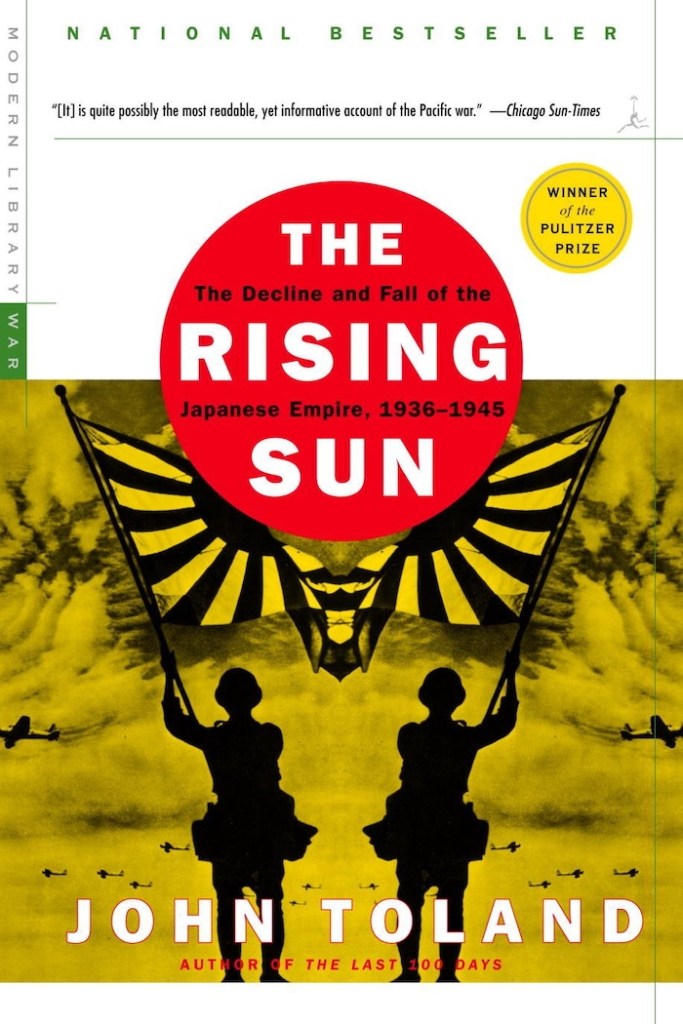
The Rising Sun: The Decline and Fall of the Japanese Empire, 1936-1945 by John Toland documents the beginning, middle and end of World War II as it concerned Japan. It is brilliantly researched and written, hence winning the 1971 Pulitzer Prize in the General Nonfiction category. I didn’t realize this was such a much-needed read for me. I had learned of the Germany’s side of the war, as well as Great Britain’s and the United States. However, I realized I hadn’t really understood what really drove the proud Japanese people in Japan, a myriad of tiny islands, to fight an enemy that was much larger.
Why was it perfectly acceptable for England and Holland to occupy India, Hong Kong, Singapore and the East Indies, but a crime for Japan to follow their example? Why should America, which had grabbed its lands from Indians by trickery, liquor and massacre, be so outraged when Japan did the same in China?
Author
One of the more shocking aspects is how much more involved Japan was in the war than what is generally known. For most, bringing up Japan and World War II would likely invoke the Pearl Harbor bombing, maybe a little of Iwo Jima due to the famous photo taken of the soldiers planting the US flag on top of Mount Suribachi, and of course, the eventual use of the atomic bombs that forced the Japanese eventual surrender. The story and events, however, go much, much further than that. The Rising Sun goes through all the important details of the story without bogging you down with the minute details of each and every event.
“…THIS TIME WE MEAN IT, THAT THE DEADLINE ABSOLUTELY CANNOT BE CHANGED. AFTER THAT THINGS ARE AUTOMATICALLY GOING TO HAPPEN.”
Tokyo’s dispatch to Nomura extending deadline of negotiations prior to attack on Pearl Harbor
Battles from Pearl Harbor, Bataan, Guadalcanal, Leyte, Iwo Jima and Okinawa along with a host of others both from the sea and air, are talked about. It also helps dispel some popular myths about the war. For example, while many have pictured the Japanese air force as nothing but kamikaze suicide bombers during the attack on Pearl Harbor and subsequent battles, it was anything but that. Another is how Emperor Hirohito was painted as a warmonger when documents show otherwise. Due to the vast differences between cultures and ideals at the time, it was hard for people thousands of miles away to understand how the Japanese people of that era functioned and behaved.
“I am sure we could inflict great casualties on the enemy, and even if we fail in the attempt, our hundred million people are ready to die for honor, glorifying the deeds of the Japanese race in recorded history!”
War Minister Anami
The Rising Sun gives one as full a picture as one can get of the rise and fall of Japan before and during WWII. Post-war Japan is not exactly discussed in this book. As proved in the book, the circumstances that led to so many events in this war, specifically before the attack leading up to Pearl Harbor to the finale of the atomic bombs dropping which could have been prevented, is truly amazing when examined in hindsight.

 The Mindless Catalog
Leave a comment