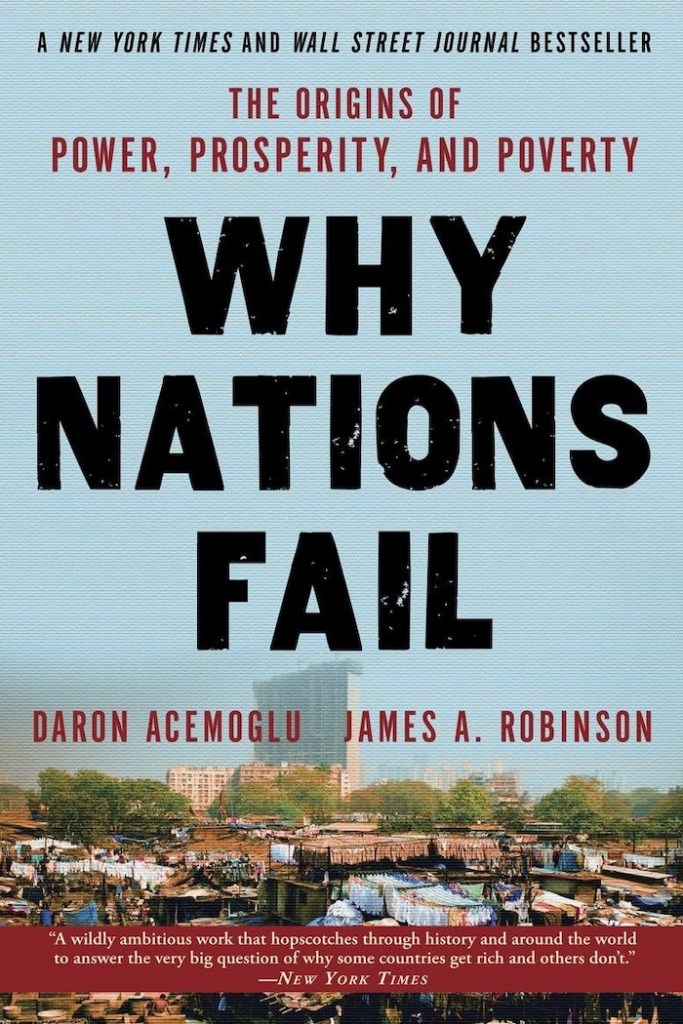
Why Nations Fail: The Origins of Power, Prosperity, and Poverty by Daron Acemoglu and James Robinson is an incredibly insightful book on just why is it that some nations are prosperous while many others are not. The authors go to explain how and why many explanations conjured up by economists regarding this topic get it wrong. Rather than chalk it up to the ignorance of political policies by the nation’s leaders to geography and culture, the reason the authors came up with instead deals with the human aspect instead. As some readers might have guessed, dictators leading an authoritarian regime are more than likely not to prevent a nation or country from developing sustaining growth, keeping the citizens poor and uneducated all while extracting the resources of the country for their own benefit. As the authors have determined, nations either have inclusive political and economic institutions to help foster growth and prosperity for the many or extractive political and economic institutions in which it helps to keep the majority poor and in poverty except for the few elites.
“Thou aimest high, Master Lee. Consider thou what the invention could do to my poor subjects. It would assuredly bring to them ruin by depriving them of employment, thus making them beggars.”
Queen Elizabeth I
Get use to reading these terms and phrases as it’s basically on repeat for the entire book and in every single chapter. Yes, it gets very, very redundant, but in the author’s defense, it just goes to highlight the entire theme of the book of why nations fail while others didn’t. There are many examples given as to why the United States, Western Europe, Japan to Botswana have prospered while Eastern Europe, North Korea, Latin America to the sub-Saharan Africa is in extreme poverty. The common theme that unites all these poverty-stricken nations? Dictators and their extractive political and economic institutions in which power is concentrated in the hands of a very select few.
Most economists and policymakers have focused on “getting it right,” while what is really needed is an explanation for why poor nations “get it wrong.”
Authors
Why Nations Fail is like a big history course for the uninitiated. Rather than mainly dealing with why these nations are failing today (although this does get discussed, just not as in depth), the authors take us back to the beginning of how these nations started along with some of the critical juncture points in which major events shake up the nation and at which point how the citizens and leaders responded started their path to either prosperity or poverty. Events such as the Black Plague and the Industrial Revolution in Western Europe played a critical role. With China, these involved the closing up of trading via sea routes during the Qing dynasty. With most poverty-stricken African nations, these involved the elites setting up the exact type of extractive institutions once independence was won. The list goes on and on to help prove the author’s point in that nations that have their wealth and power distributed to the masses does a lot better than one’s that are concentrated on the few.
The most important lesson is that extractive institutions cannot generate sustained technology change for two reasons: the lack of economic incentives and resistance by the elites.
Authors
While the book can be very entertaining, it can be a bit hard to read if not done so in chunks. Many parts and ideas are reiterated throughout the chapters. It makes me wish that the book had somewhat been shortened a bit. It does provide a lot of historical information that will keep me busy for a while looking up. For example, I had no idea an African leader actually won the lottery! Could it be somehow be that him being a dictator have something to do with it?! Or what about Argentina’s government “stealing” money from its citizens when it legally pegged the peso to the dollar and then reversing course, which ended up with the citizens losing their hard-earned savings who thought it was safer to keep their cash in dollars? There is a lot to unpack with this book and although the theme remains the same throughout much of the 600 pages and with many oft repeated parts, it still sheds light into just why a few nations prosper while much more do not.





 The Mindless Catalog
Leave a comment