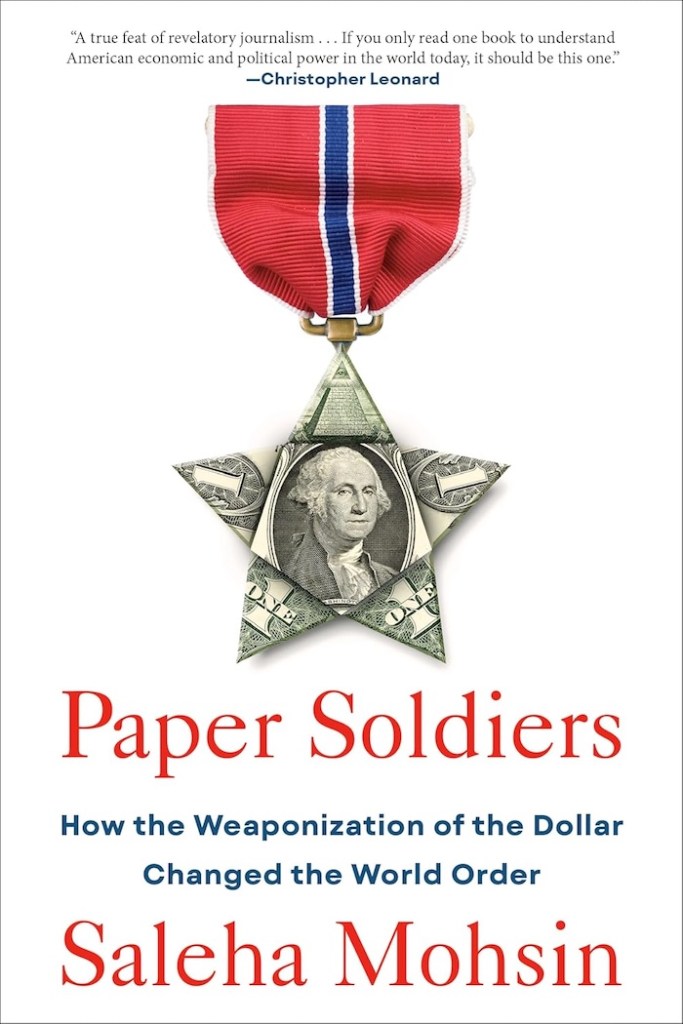
Paper Soldiers: How the Weaponization of the Dollar Changed the World Order by Saleha Mohsin talks about a critical topic concerning both today and the future in regard to the world’s most used currency, the United States dollar. Over the decades, the dollar has been slowly used to transform both the economic landscape around the world and, more recently, using it as a weapon to further United States foreign goals. But is this a wise choice? There’s always been talks that one day, a different currency will replace the dollar. Nothing lasts forever. With the United States more and more often flexing their power, they have slowly over the decades started weaponizing the dollar, mainly via sanctions, to punish foreign countries and adversaries. But this flexing of power and “bullying” comes at a cost in that even allies of the United States are starting to have doubts whether sticking with the almighty dollar is smart as one day they may find themselves on the other end of the sanctions list and just like that, locked out of their country’s asset reserve in dollars. It’s a high stake game that is for the United States to lose as the incumbent, and one that will have dramatic worldwide consequences.
“Faith in democracy and faith in the markets go hand in hand.”
Robert Rubin – 70th U.S. Secretary of the Treasury
Paper Soldiers is written by a Bloomberg journalist and it shows. The book seems like one very, very long, researched article. For the majority of it, Saleha talks about the many Treasury secretaries of our history, the very stewards of the dollar currency. They are supposed to be apolitical. Their main task is to be the guardian of the most used currency in the world and to keep it that way. We learn very quickly how the dollar currency was created and how it became to be the world’s currency after World War II. A large portion of the book also goes over how Treasury and the markets, particularly in regard to the Wall Street traders, have over time been linked to one another. The scrutiny of each new appointed Treasury secretary over the years have come to relied on “strong dollar” mantra to calm markets and project strength in the US dollar. However, while a strong dollar is good when it comes to globalization, it has upended the lives of many in the manufacturing sector. Saleha also helps to show us that after the terrorist act of 9/11/2001, the weaponizations of the dollar became a real thing.
“A strong dollar is in our national interest.”
Robert Rubin – 70th U.S. Secretary of the Treasury
Paper Soldiers I think would pair very well with The Lords of Easy Money. A common theme highlighted in both is how it can be seen by the public eye of the nation, putting the interests of the wealthy above the common people and everyday workers. Bailing out huge corporations at the expense of taxpayer dollars for the very crisis that they helped create in the first place definitely still have people feeling the gut punch till this day. Yet, what is the alternative? The United States has always had the need to project strength and stability. That is one of the consequences of having the dollar as the world’s most used currency. The dollar needed to remain strong in order for the US to get cheap imports from China and other countries to feed into our consumption economy. Yet, the problem has brewed for far too long for it to be further ignored. Saleha goes to show how each administration throughout the years as approached the “China problem”. She helps highlights how both the United States and China have a mutual dependency with each other. While previous administration’s seems to have been walking on egg-shells when dealing with China in hopes of slow but gradual increase of their currency, we are now in the phase of aggressive tariffs being levied with little disregard to how it will also affect the US.
One damaging side effect of a stated policy desiring strong dollar was that it meant that the government was choosing winners and losers in the economy, a betrayal that rarely amounts to good policy.
Author
I liked Paper Soldiers but would have preferred much more input and thoughtful opinions from either the author herself, or if that sounded too bias, then from the many interviewees she spoke with on the different topics discussed. Currency manipulation being used as a weapon is a real thing. Purposely driving down one’s own currency to boost export, like what China has been accused of doing, is now taking center stage as the manufacturing problems we are having at home is also taking the front page for all to notice. Will the US go back down the same path in which it has weaned itself off from doing in the previous couple of decades? With the political scene being so divided and unpredictable now, more than any other point in history, can other nations continue to keep their faith in the United States’ democratic institutions being upheld? Paper Soldiers explores these themes and more where the dollar currency is concerned. It will truly be interesting to watch how things unfold in the next decade or so.



 The Mindless Catalog
Leave a comment