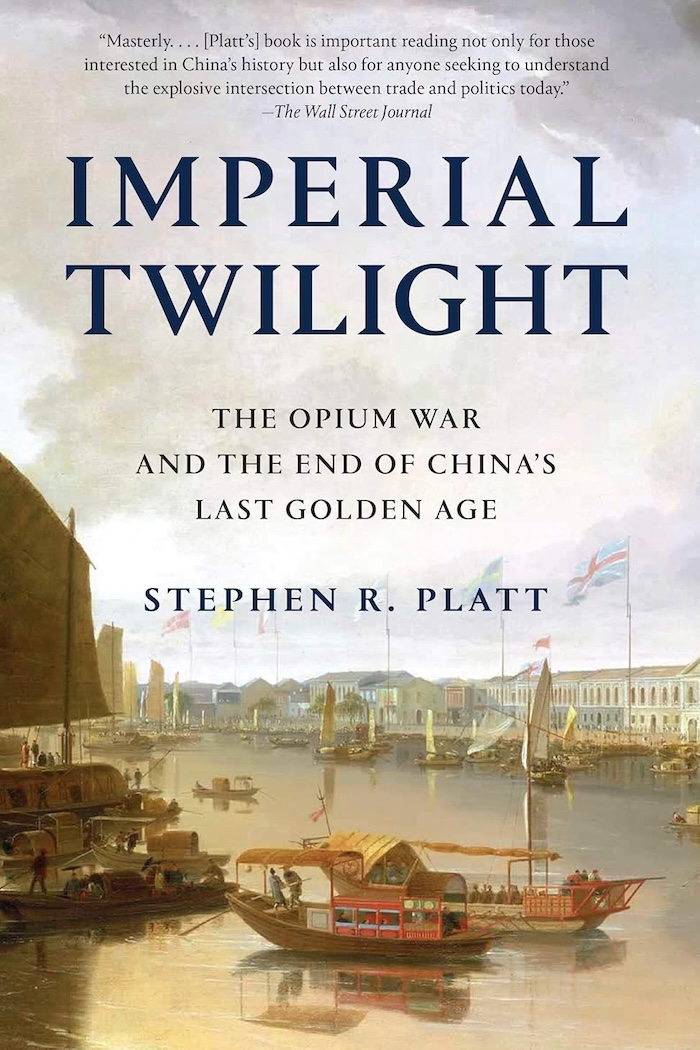
Imperial Twilight: The Opium War and the End of China’s Last Golden Age by Stephen Platt goes over one of China’s most embarrassing moment in its imperial history that still plays a role today in how modern China behaves. The Opium War fascinates me so much because I’ve seen it play a role is so many of the kung-fu movies I’ve watched growing up. At the time, I was extremely curious to understand just why were there so many white foreigners in China. When visiting Hong Kong, I also was confused as to why there were so many British foreigners living there. It was a time when so many people were scared and anxious about what would happen in 1997 once the British had to hand Hong Kong back to China. Hand back? What ever did the British do, for better or worse, to deserve a 99-year lease of Hong Kong? Turns out The Opium War had a lot to do with it, and this book gives a very good insight as to how that came to be.
“When foreigners who come seeking audience with me are sincere and submissive, then I always treat them with kindness. But if they come in arrogance, they get nothing.”
Qianlong Emperor
I’ll get one of the first negative thing out of the way first, depending on how one looks at it. While Imperial Twilight obviously highlights The Opium War, a very big percentage of the book goes over the events that lead up to it. How big of a percentage? Well, the book is divided into three parts. In the entire first part of the book, which comprises multiple chapters, I don’t remember the author even uttering the word “opium” once. That’s 33% in a 550+ page book (including the very long sources in the end). This first part though is still necessary reading to understand why or how things happened the way they did in part two and three. I guess some readers may feel impatient enough to skip through some of this, but I’d advise not to. While yes, it may at first seem mundane and unnecessary to go over George Staunton’s role as a Chinese interpreter or Robert Morrison’s creation and translation of the dictionary and Bible in Chinese, these were all things that played a very heavy role in the events to come prior to what led to the war. Details and events on the two failed embassy mission to Beijing to court the emperor, for example, are also crucial to understanding the events that were to unfold. Therefore, patience is warranted.
“You would doubtless, at first succeed,…but you would teach them their own strength.”
Napoleon Bonaparte on war with China and how it will awaken the slumbering dragon.
The second negative thing that needs to be pointed out is that Imperial Twilight absolutely ignores the second Opium War altogether. This is a shame because although the author went over how China started its decline once they had to concede to the British in the first Opium War, the second war from 1856 to 1860 led to much more territory that they had to cede. Imperial Twilight does an excellent job at gearing the readers on just what led to the slow decline in relationship between the British and Chinese traders in Canton that lasted for many, many decades but fails to finish the overall project. I would have liked to see even a small section at the end dedicated to going over, even if not in full details, of The Second Opium War and the results. Because much of the information on why the war started had already been established in the first war throughout the book, I wouldn’t have thought going briefly over the second war would take much effort. However, I now feel the need to either have to resort to Wikipedia or another book on the opium war to cover this huge hole.
“Trade with China is our only object; conquest there would be as dangerous as defeat, and commerce never prospers where force is used to sustain it. No glory is to be gained in a victory over the Chinese.”
James Graham – First Lord of the Admiralty
One of the biggest question Imperial Twilight seems to want to answer in regard to The Opium War, a question which lead me to reading this book in the first place, is just how involved, both morally and financially, were the British when it came to China’s decline in the 19th century via the opium trade? Imperial Twilight highlights how China/Canton was nothing at the time but just a cash cow via trade to the British. In a time when a single letter correspondence took nearly half a year to get to and from China along with how delicately the British government treated the relationship, it can’t be that much of a surprise to discover that, over time, events unfolded the way they did. This was especially true once the mythical bubble and allure of China being this super country with 1/3 of the earth’s population was slowly burst. It goes to show that while the British had a lot of do with the opium trade in China, the Americans accounted for nearly 1/5th of the import. Both countries relied on the opium trade to enrich themselves. Finally, Imperial Twilight helps us learn just how differently things could have turned out where if only a few things had changed, for better or worse. As mentioned earlier, though, readers looking for a complete one-stop shop on The Opium Wars will not get that here.

 The Mindless Catalog
Leave a comment