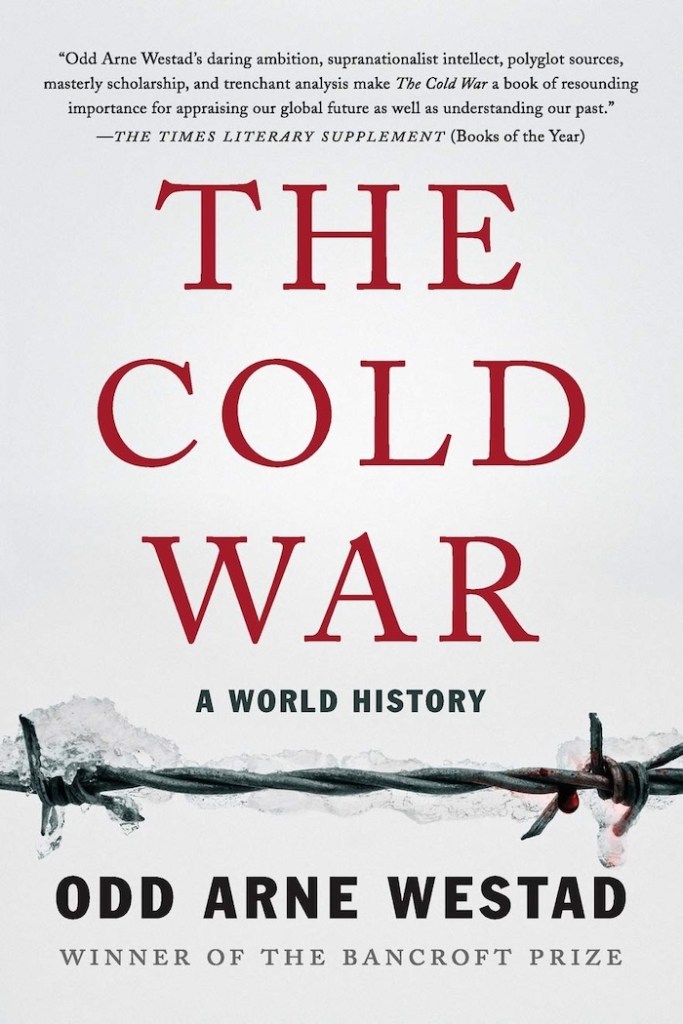
The Cold War by Odd Arne Westad goes over in painstaking details one of the most tumultuous events, spanning several decades, post-World War II. Here is yet another crucial point in human history that was only briefly glanced over during high school history, and yet, the events that occurred shaped not just the United States and the Soviet Union in the later half of the 20th century but rather involved the entire world over and involved how things are in the 21st century as well. This was a common mistake I had made in my early years, where I had believed that the Cold War involved just two countries with different ideological ideas and beliefs on how a country should be run. This book goes to show that nothing could be further from the truth. However, bear in mind that this is not an easy read. There are likely other easier books for the novice armchair historian to dive into that deal with this complex subject, along with online documentary videos. If you’re ready for a challenge, though, be prepared. The Cold War will likely make your head spin and reel with how many details, countries, parties, dictators and wars there are by the end of it.
History is complex. We do not always know where ideas will lead us. Better, then, to consider carefully the risks we are willing to take to achieve good results, in order not to replicate the terrible toll that the twentieth century took in its search for perfection.
Author
One of the main ideological divide that separated the West from the East is about whether a country should be run via socialism or capitalism. This is an extremely crucial element in understanding The Cold War. Due to my lack of knowledge in this area, I found myself struggling in certain parts of the book. Due to how broad The Cold War covers in this period of time, it doesn’t go over this area in many details, and so I highly suggest readers familiarize themselves on this topic, even if just a little (Wikipedia or YouTube will likely do). The nuclear arsenal and military armament that The United States and The Soviet Union developed also played a huge role in how The Cold War started. The author goes to show how each successive U.S. president thought and dealt with The Soviet Union in this aspect. While the public thought both countries were playing a game of chicken in which the fate of the entire world was at stake, we learn that this was not always the case backstage where the major players were concerned.
It was not that eastern Europeans on a whole were living worse lives than before. It was that many of them knew how much better people in western Europe were living and how quickly progress was made there.
Author
A very large portion of the book deals with how each individual country dealt with both The United States and The Soviet Union during the Cold War period. Personally, this is the meat of the book, which shocked me the most. It is literally a showdown between the West and the East in who can bring more countries to their side of the battle. In a period in which the thought of colonialism was being disparaged and uncivilized by protesters in the West, it put a lot of pressure on Western Europe to let countries they’ve lorded over for so long to their own devices. It is here where capitalism and socialism, each weapon wielded by their respective owners, sought, at times what looks to be with any means necessary regardless of lives and expenses, to convert these new countries over to their side in the war. The author goes over each region of the world and goes to show how The Cold War affected them. This includes Western Europe and Germany, Southeast Asia, Latin America, The Caribbean, The Middle East, China, Eastern Germany and all the republics of The Soviet Union themselves. I couldn’t believe how I once thought that The Cold War only dealt with the two Superpower themselves.
Instead of only acting as an example it had to intervene to set the world right; the world needed not only American ideas but American power.
Author
The Cold War, I believe, is an excellent addition to your history collection of books. As mentioned earlier, though, it may not be easy reading for beginners. So many political terms are thrown out there, such as socialism, communism, capitalism, Leftist, Rightist, separatists, along with the very ideas of how society functions based on these, which can at times make it really hard to keep track of whose who and what is what. What it does the best is to highlight to the readers that The Cold War was not just relegated to two Superpowers of that time. So many other events and war ultimately changed the structure of the war in ways that no one really could understand fully at that time. It goes to show how The United States had put so much emphasis on preventing communism from taking root that it was willing to support and put brutal and violent dictators onto the throne just because they likely thought it was the lesser of the two evils. Although late to the game, I’m glad to have read and learned of The Cold War. This book provides such an incredible learning experience for a global event that is shaping how we live in the 21st century as well.
 The Mindless Catalog
Leave a comment