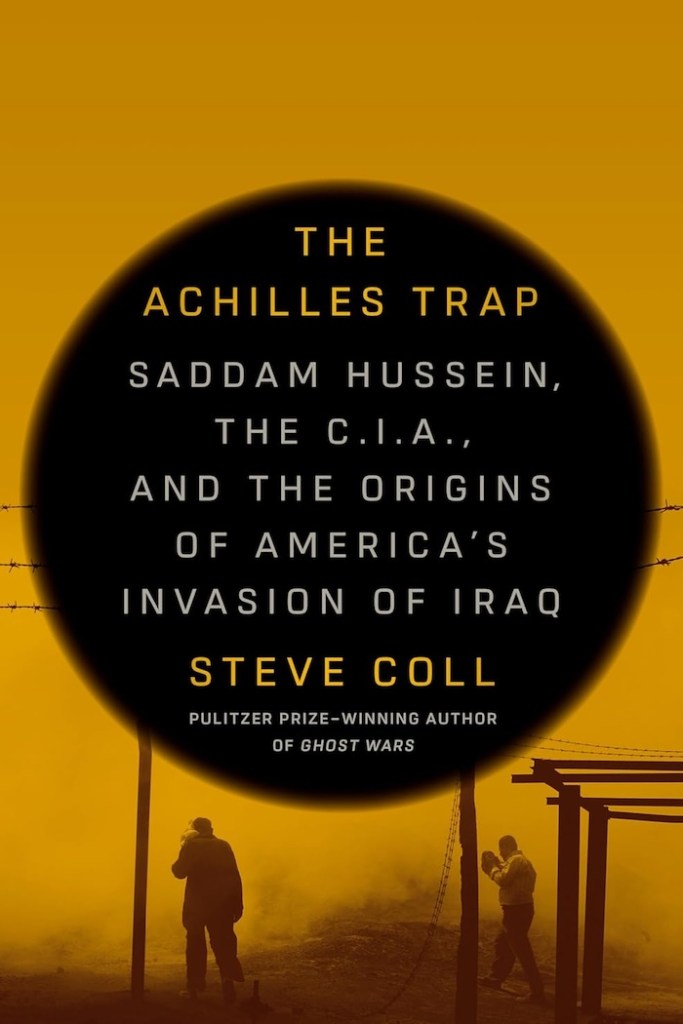
The Achilles Trap: Saddam Hussein, the C.I.A., and the Origins of America’s Invasion of Iraq by Steve Coll helps readers understand, as the title implies, the war against Iraq’s Saddam Hussein and how the continuous search for weapons of mass destruction ultimately led to their invasion by the United States. The Achilles Trap presents us a highly readable narrative that makes digesting the information so much easier. It is usually because of this form of high-quality narrative presentation that reading non-fiction books, regardless of size, is so much fun. While getting all the nitty-gritty details can be important, it’s usually not necessary for the average reader. Here, the author, I believe, has done a great job of balancing what I’d assume to be an insane amount of information, just based on the number of citations listed at the end of the book, and what should be included for readers to effectively tell the story of how Saddam’s regime ended.
The premise was that a credible threat of war could persuade Saddam to “come clean” about his presumed WMD arsenal. No consideration was given to the possibility that he had nothing to come clean about.
Author
It is absolutely bewildering how the Cold War has shaped world history. If you found The Achilles Trap to be fascinating, then I highly urge readers to follow up with learning about the Cold War as it has so many ties to not just the story presented here but also worldwide politics as well. To try and sum up The Achilles Trap, I believe it can be boiled down to a very unfortunate misunderstanding between the two countries. Why that is so is what makes the book a highly interesting read. For the general United States public at the time, the reasons for going to war with Iraq sounded very righteous when presented in the media. Few would have known or even believed that a lot of money and lobbying went into that presentation. However, the evidence presented to our top leaders at the time had somewhat made it clear, or at least to the point that the invasion was not justified, that no weapons of mass destruction could be found. The most interesting part of this story now that we have the benefit of hindsight and unclassified documents to pore over is how the United Nations, and especially the United States, made it almost practically impossible for Iraq to receive a clean bill of health in regards to their nuclear program.
“We went down the road we did, and reached a point of no return. Therefore, we must continue to the end.”
Saddam Hussein
The United States needed to make an enemy out of Saddam Hussein after Iraq’s invasion of Kuwait. Once they discovered his secretive nuclear, chemical, and biological weapons program in the early 90s, they were hellbent on finding additional weapons of mass destruction for the better part of the decade, and they were not going to stop until they found something, regardless of how Saddam’s regime and scientists had repeatedly denied restarting the program. The author does a good job of presenting Saddam’s story here as well and makes it clear that while his regime did some very nasty things, in regard to the decision to invade Iraq based on weapons of mass destruction, it was an unfortunate event that led to the destruction of many lives on both sides of the war.
“As concerned as we are about Iraq’s chemical, nuclear, and missile programs, we are not in any sense preparing the way for a preemptive military unilateral effort to eliminate those programs.”
April Glaspie
Like so many non-fiction books, I find that while I was a bit confused as to why I’m reading a certain book or even as to why I chose it in the first place, once I got started, I could hardly put it down. The Achilles Trap belongs in that category. I think it could have benefitted from pictures of the more prominent figures in the story, as there are definitely a lot of them to keep track of as it progresses. As it is, be prepared to do a lot of searching on your phone as you read this incredible story, as you’ll want to put a face to the characters. I remember reading and watching in the news about Saddam’s capture at the time. Prior to that, I remembered getting chills when I saw on the news the demise of both his sons. Somehow that signaled to me that the end had to be near and things were getting real. I finally remembered how I cheered along with likely so many others when Saddam was found guilty of war crimes and finally executed. Little did I know how this came to be and how complicated a story it would turn out to be.




 The Mindless Catalog
Leave a comment