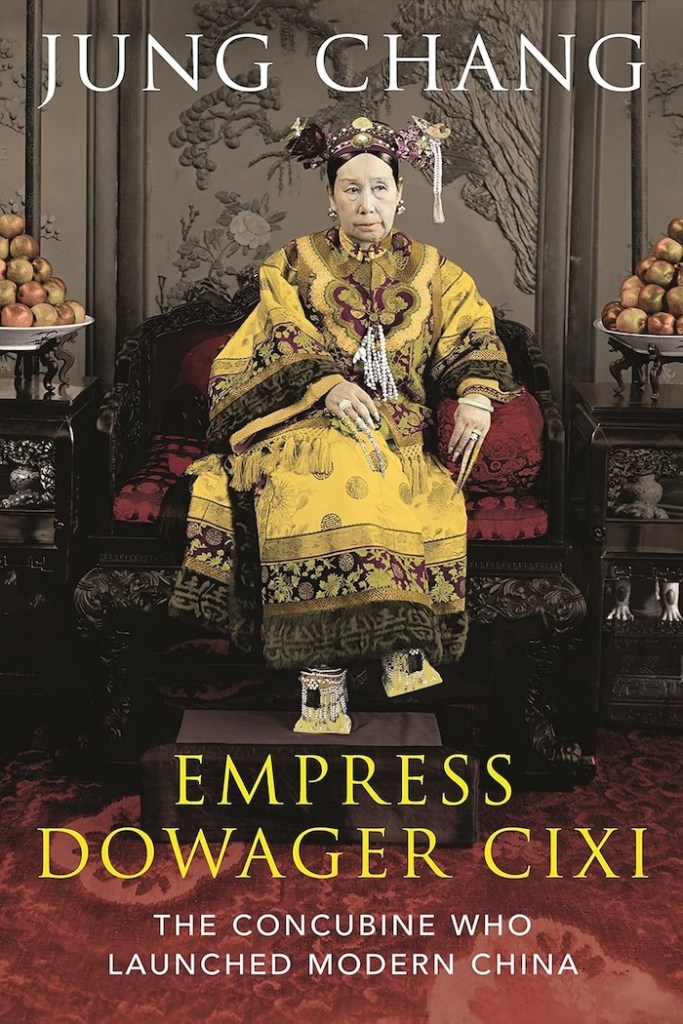
Empress Dowager Cixi: The Concubine Who Launched Modern China by Jung Chang goes over the last few decades of China’s last dynasty, The Great Qing. Focusing squarely on the Empress Dowager Cixi, it covers the early days of her life to how she became the de facto ruler of China despite all odds. All roads lead to China, and how can it not? Regardless of how much world history there is to learn and discover, I find myself yet again drawn into the imperial world of pre-modern China. Part of that great mystery is discovering and learning how such a large empire fell to the Western world. While the Opium Wars were a start to China’s foreign problems, it is only afterwards, from the 1860s and beyond, that we really must pay special attention to, as history provides us with a view of just what China did and didn’t do that ended its 2000-year monarchy. Ironically, it wasn’t a male who ruled the last days of pre-modern China and brought it to modern standards, but rather a female.
“The time would soon come, however, when the people of China will be so educated and enlightened as to know what their rights are, public and private, and to have the moral courage to assert and defend them.”
Yung Wing – first Chinese graduate from Yale University
The author here aims to help correct and make clear that throughout modern history, Dowager Cixi was not looked upon as a heroine nor given enough credit for her work in launching modern China with its many reforms. Given that females were generally looked down upon in those days, one can likely agree that there is some truth to this. However, going through previously sealed documents and communication memos of that era for the first time ever, the author is able to help paint a picture that hopefully puts the spotlight back on the dowager as far as giving her credit where it’s due in terms of helping to bring China out of its old ways and into the new 20th century. If you don’t care about all that, then that’s fine as well because the story of the dowager herself is enough to make you glued to this book.
“If we are able to do what they are doing, there is no question we, too, can be rich and strong!”
Zhigang – official who toured the European countries in late 1860s
While I’ve learned, as well as many others, that the last emperor of China was Puyi, it was purely symbolic. The Last Emperor, directed by Bernardo Bertolucci, is a must-see movie that goes over his story. I felt that while yes, Emperor Puyi’s story was special in its own ways, at the time, though, I remembered I was mainly interested mainly because he was the last male emperor of China. Because imperial China was largely ruled by a male throughout its entire history except for the case of Wu Zetian, it made his story that much more alluring. What I’ve now learned here is that prior to Puyi coming of age, it was the Empress Dowager Cixi who made changes to China that would last and have a profound impact even till today. For example, it was she who suggested creating an elected parliament for the first time in the history of China at great expense to her dynasty. It was also her story presented and that we shall learn here that describes how much she had to scheme and plan to be the decision-maker for all important political issues. At a time when both her husband, her biological son, and adopted son were weak rulers, she had to be the one to step up to the political pressure of foreign powers.
“When it comes to China’s relationship with foreign countries, it is of course better to have peace. But before we can have real peace China must be ready to fight. If we give in to every demand, then the more we seek peace, the less likely we are going to get it.”
Empress Dowager Cixi
Make no mistake about it though. The author, while at times may seem biased to some, has admitted that Cixi, like any other ruler of any age, has both desirable qualities as well as many flaws. The book here presents a picture of Cixi that, while yes, tries to give her credit for the many actions and policies she’s put in place over the many decades of her rule, also lets us know that she could also be a ruthless person, especially when dealing with rebellions and people caught in plots against her life. I personally can’t help but read and learn more about China. There are times when I’m not even sure why. However, I usually find that once I start, it can be difficult to quench that thirst for knowledge on one of the largest empires to have graced this world. Empress Dowager Cixi is a fine read, and I encourage readers wanting to learn how China first got started in the modern age to pick it up.


 The Mindless Catalog
Leave a comment