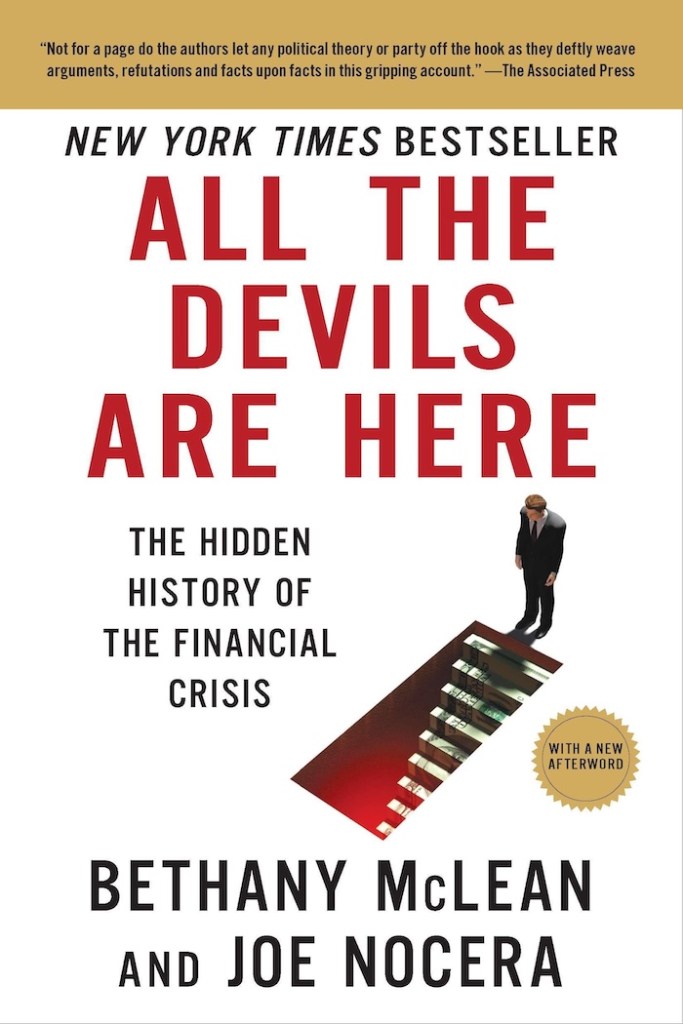
All the Devils Are Here: The Hidden History of the Financial Crisis by Bethany McLean and Joe Nocera goes into great detail on how the Great Financial Crisis of 2007-2009 came to be. It was either this book or “Too Big to Fail” by Andrew Sorkin. I chose the former because it’s supposed to go further back and really dig into how the crisis got to where it was prior to blowing up, whereas the latter focused more on the event itself. Secondly, I think that at this point the authors could write a book about the history of different paint colors and I would likely read it. Being a huge fan of The Smartest Guys in the Room, I just knew that All the Devils Are Here would be another absolute smash hit. During the GFC, I remembered I was jobless, and so the hard times hit me harder than others, but I had no clue why or what caused it. It wasn’t until a decade or so later, when I finally aimed to be more financially literate, that understanding this event was under my crosshairs.
Nobody in his or her right mind would establish a company whose competitive advantage was built on a guarantee that was nowhere written down and that no one could say for sure even existed. Yet that was the premise upon which Fannie Mae and Freddie Mac had built their dominance. Their advantages were based in large part on the belief by investors that the government would never let the GSEs default.
Authors
All the Devils are Here more than met my expectations. As expected, rather than jumping directly into the crisis as it unfolded during 2007-2009, the story slowly, chapter by chapter, wove together the how’s and why’s. This wasn’t easy, as there was a lot for the authors to unpack. Fortunately, they were both up to the task. Everything from Fannie Mae and Freddie Mac, subprime mortgages, derivatives, credit default swaps, collateralized debt obligations, Congress, the Federal Reserve, regulators, Wall Street firms, traders, and the whole nine yards is discussed, along with the part each played in bringing the crisis about. Spoiler: almost everyone and everything is guilty. It’s truly fascinating and horrific at the same time how inefficient our government can be. It’s astounding how everything can be put aside at the expense of making ever more profits for shareholders. On Reddit, I used to remember people talking badly about the three big rating agencies, Fitch, Standard & Poor, and Moody’s. I never understood why that is. Until now.
“If they have a house, if the owner has a pulse, we’ll give them a loan.”
Russell Jedinak
If there’s one important thing to learn here regarding the crisis, it’s that so many people got away with doing so much damage. All one has to do is continuously lie, and not just that, but if you continue to believe in those lies, it’s the perfect alibi. Ok, so your company got sold and taken over. But who cares if you got paid out a big bonus? Sure, you’ll be infamous, and your name will forever be linked to this great period in history, but again, who cares if you’ve cashed out? When I constantly hear about protests and anger in regards to the government bailout of big companies back then, I wasn’t exactly sure of what that meant. Now I do. And yes, it will ultimately make your blood boil. There likely isn’t a more apt title than Andrew Sorkin’s Too Big to Fail. These companies, along with their incompetent leadership, are highlighted each step of the way, and it really makes one wonder just how much of that is still going on today in our top companies.
Here’s a surprising fact: it was the government, not Wall Street, that first securitized modern mortgages.
Authors
If there’s one negative to All the Devils are Here, it’s that I think it focused just a bit too much on the past, even for my liking, and not enough on the actual crisis when it finally blew up. I think for that part, I’d still have to read Too Big to Fail someday. Fortunately, the authors have quoted many sources for the readers to follow up with should they want even more information on what went on. I think in today’s financially connected world and infrastructure, it’s only a matter of time before Wall Street and other big trading firms create yet another highly speculative trading instrument, if they haven’t already, and blow things up again. The Great Financial Crisis shows how much good can be sacrificed by big companies and the government themselves for just a little higher yield. But people have short-term memories. Surely next time, things will be different?



 The Mindless Catalog
Leave a comment