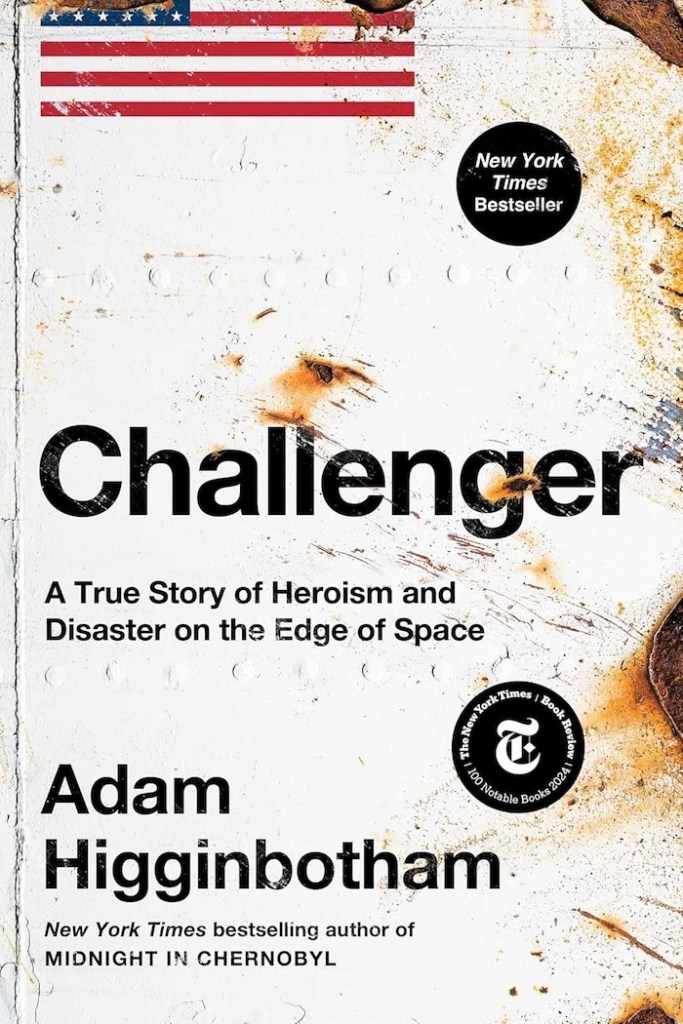
Challenger: A True Story of Heroism and Disaster on the Edge of Space by Adam Higginbotham details the tragic accident of the Space Shuttle Challenger disaster in February of 1986. I was excited to learn about this incident and knew the book and story were in good hands with Adam. Having read and absolutely loved Midnight in Chernobyl, I knew he would bring the same no-nonsense style of writing and investigation to Challenger as well. Challenger presents us a story of not just the demise of the space shuttle itself, obviously, but what unfolds prior to that is a story of how the mounting pressure of the public, along with the various parts of government, slowly led NASA and their contractors to eventually drop their guard and ignore safety issues to satisfy an unrealistic timeline of shuttle launches.
“For a successful technology, reality must take precedence over public relations, for nature cannot be fooled.”
Richard Feynman
What I found most interesting, and I assume I’m not alone in this, is how such a massive project of brilliant mankind invention that costs billions and billions of dollars to accomplish can be brought to disaster by such a seemingly small thing. In a situation where so many parts, components, and processes must work harmoniously together to ensure mission success, could it be any wonder, though, that as time progresses, some of the seemingly lesser problems get ignored or judged an “acceptable risk” so that the mission itself isn’t jeopardized? When reading Challenger, I often envision my naivety in my younger years when I had always assumed that a work environment with more people, departments, oversight, sign-off sheets, and the whole nine yards would make for a much safer place to work. I believe the term used when describing this would be a “well-oiled machine.” When I personally got to work in such a bigger work environment, I found it can many times be exactly the opposite. Here is where the Challenger suffered its worst enemy.
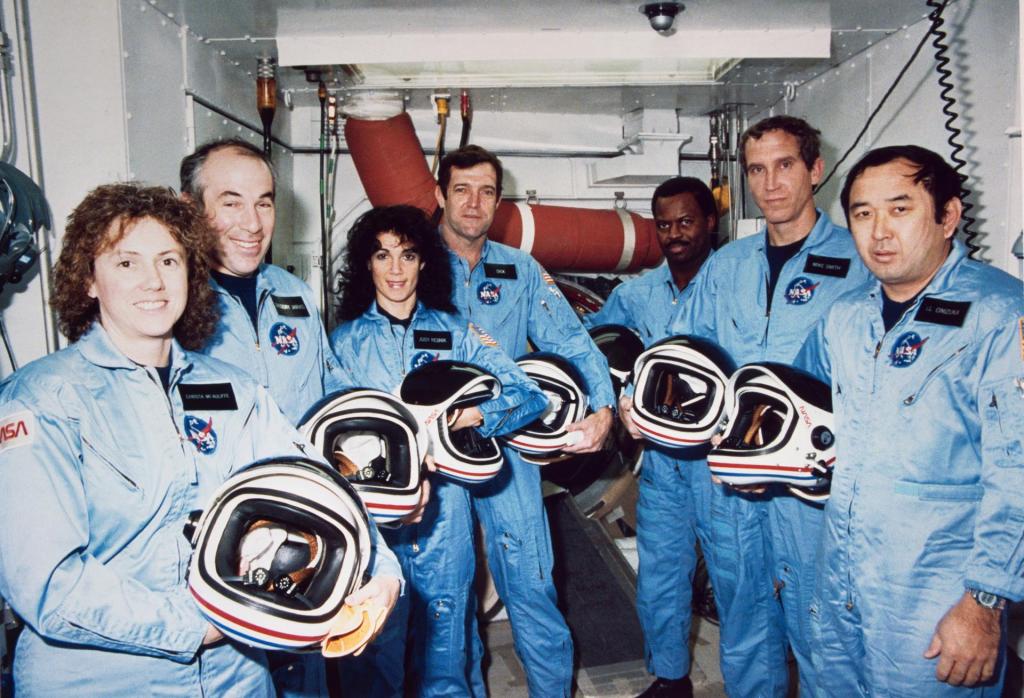
“They don’t delay unless it’s not perfect. And that’s fine with me. I’d be much happier if it went up when everybody thought it was perfect, then they go up on a chance basis.”
Steven McAuliffe
Instead of focusing on just the negative aspect, Challenger spends a lot of time giving the readers a brief history of NASA along with the many astronauts that came to be over the years prior to the Challenger’s demise. The Apollo 1 fire incident was one of the scariest and most horrifying audio recordings I’ve witnessed. It’s right up there with the cockpit audio of Japan Airlines Flight 123 in terms of just how horrifying it can be to be stuck in such accidents with no way out. The other horrifying aspect of this story is the later chapters when it focuses on the investigation into the accident itself. I couldn’t even imagine what the families had to go through when they discovered how the event unfolded after the explosion.
“It’s what I don’t know that scares me the most.”
Allan McDonald
Incidentally, while I got towards the end of reading Challenger, I saw a video recommendation on YouTube in which NASA was broadcasting live the return of the SpaceX Dragon Freedom spacecraft from orbit. It was surreal to see it actually live and along with many of the processes described in the Challenger book playing out on my screen, such as the “blackout communication” period. Space Shuttle launches have obviously come a long way. But it’s true that the general public may not be as enamored with it as they were during its inception days, and that in itself was a part of the problem for Challenger and the rest of the other shuttles of the past.



 The Mindless Catalog
Leave a comment