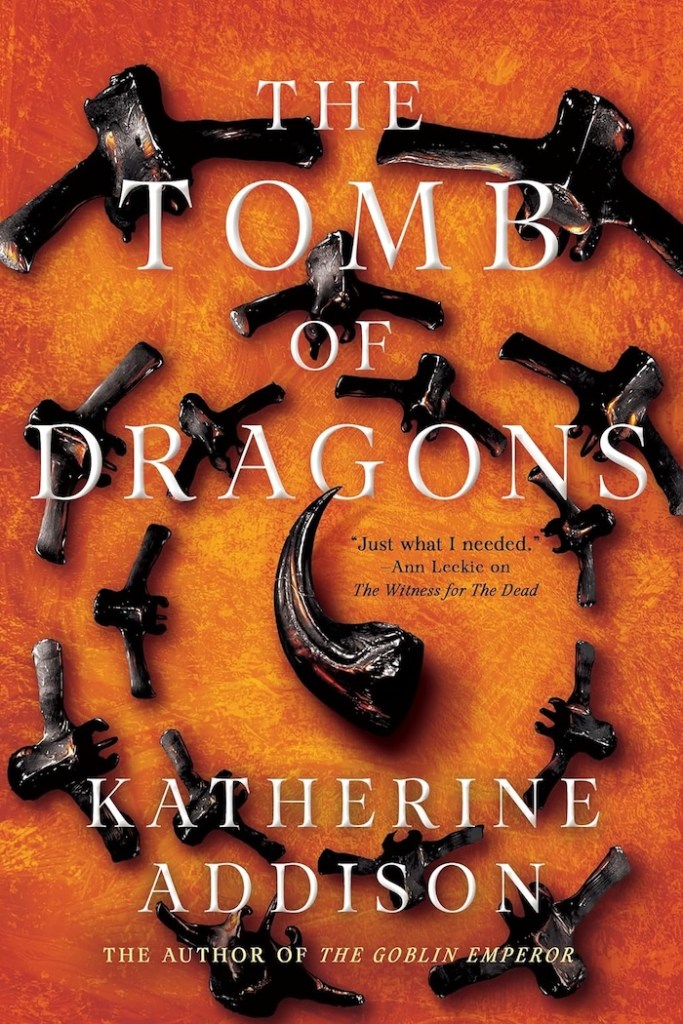
The Tomb of Dragons by Katherine Addison is the third and final book in the Cemeteries of Amalo Trilogy. I’m definitely sad that this great trilogy is ending but also can’t wait to see what the author has in store for her fans with whatever project she has upcoming next. In this last novel of the series, we once again follow our favorite prelate of Ulis, Thara Celehar. And just like the previous two novels, The Witness for the Dead and The Grief of Stones, we get to witness Othala Celehar get intertwined in some pretty chaotic scenarios and mysteries. For fans of the series, expect the same old approach, but at the same time, we get a more intimate and personal look at Thara Celehar. How else better to describe this series but as a slice-of-life fantasy?
…That’s politics anywhere. It is why I prefer the company of the dead.”
Thara Celehar
In The Tomb of Dragons, Thara Celehar gets embroiled in multiple mysteries and events in which some tie in with the others. We have an escaped prisoner, a murder in the Vermilion Opera, a non-functional cemetery that Thara Celehar is tasked to make functional again, and being made a witness for the deaths of hundreds of dead dragons beneath a mountain. How cool of a dragon name is Jormentauren?! I’ll sound like a broken record by now, but there’s a reason why the series is so beloved. I’ve long moved past reading your typical fantasy and dark fantasy novels involving crazy sword fights, magic systems, and the typical weak male/female who then grows to become a legend either through training or sheer luck. Series like The Cemeteries of Amala and The Goblin Emperor are what I’m only interested in going forward in which we have a protagonist who dutifully does their duty without complaint and is good at it as well. This was executed brilliantly in The Tomb of Dragons.
“Some people will do anything to stop change. And yet change always happens anyway.”
Doret Athmaza
While I don’t have an issue with the multiple issues that Othala Celehar faces in the story, I was just a bit disappointed that the plot regarding his witnessing for the dragons was cut so short in favor of the others. I would have thought that with the book being named as it is, this task would have more time to be explored and worked on. Because of this, I felt the conclusion of this task felt, while not exactly rushed, more subdued and not as impactful as I had hoped. But nonetheless, I’ve still thoroughly enjoyed this novel. It was a bit hard at first to get back into this world the author has built for us. Mainly, a lot of the elven/goblin names for places and titles got me very confused. In fact, I remained confused for some of them, especially the court names, throughout various parts of the story. Fortunately, it didn’t distract too much from what Celehar had to do. I vaguely remember this was similar in the previous two books in the series as well.
“Perfect justice is unobtainable since the people who ought to have been punished are all long dead.”
Sorohar
To sum things up, The Tomb of Dragons is a nice way to conclude a series. However, it does feel like the author left a bit of a cliffhanger at the end. Is she hinting that a return to this world is possible in the future? Well, fans can certainly hope so. I’d believe that mature political fantasy novels and stories such as these are hard to come by. A fantasy character such as Thara Celehar, who’s not exactly an exciting one based on actions alone, somehow still manages to make me enjoy all three novels. Mature readers willing to give this series a chance will surely have a good time. Hey, if you know, you know.


 The Mindless Catalog
Leave a comment