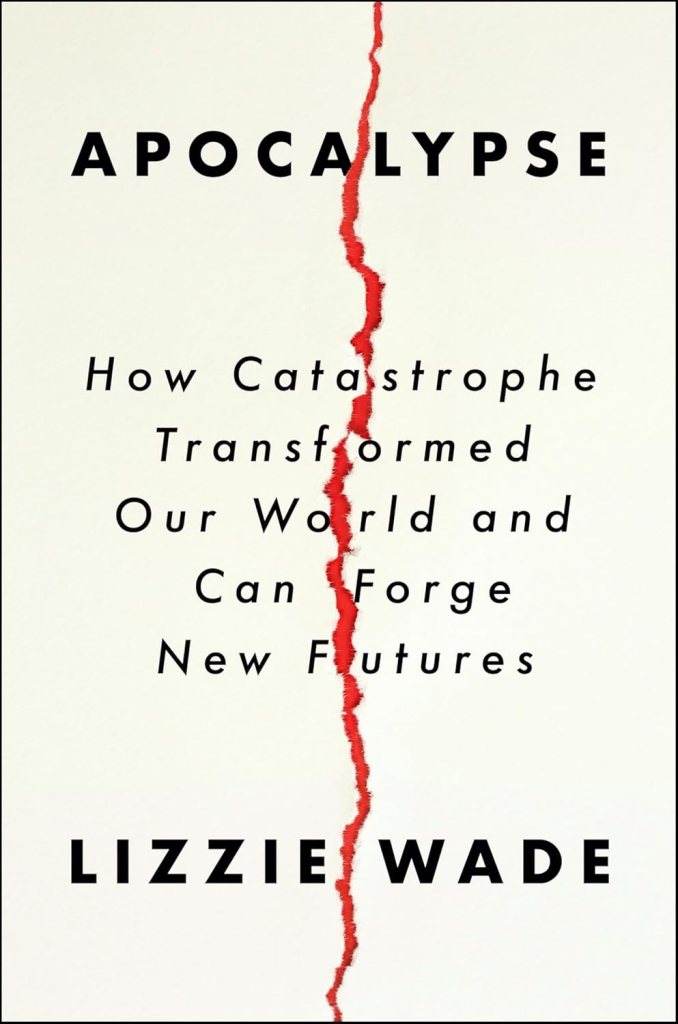
Apocalypse: How Catastrophe Transformed Our World and Can Forge New Futures by Lizzie Wade goes over some of our world’s history’s most devastating apocalyptic events, showing us that regardless of what gets thrown at us, humans eventually will find a way to survive and move forward. If you’re feeling depressed about today’s world and how it will ever survive another catastrophic event, Apocalypse can be an uplifting book to read. While it shows that not everyone will obviously survive a major apocalyptic event, those who do will eventually find ways to push the human species forward due to the need to survive in the new environment. Apocalypse does require some imagination from the author but obviously imaginations based on historical research. Each chapter usually includes a small story told through the eyes of a commoner living in that historical age and what he or she would likely have experienced. These simple stories help create a bond with the readers to highlight that humans thousands of years ago weren’t that different than humans of today.
“They didn’t run, or die, or give up. They didn’t fail or disappear. They looked straight at the apocalypse, and they build something new.”
Author
The book is broken up into three parts. It starts as early as trying to answer the question of how Homo sapiens took over from the Neanderthals and then slowly moves up in time to discuss the event of The Great Drowning concerning Doggerland, Harappa, ancient Egypt, and the ancient Mayans to COVID. Each long chapter discusses how a major apocalyptic event changes and alters not only the physical landscape of the people living in that area but also, importantly, the political and governing structures as well. Events such as the Black Death show us how the people were able to demand higher wages in the aftermath of the event, as well as demonstrating that not all governments are willing to give up power regardless of how much suffering an event may have caused to the general public.
“We need to change how we think about human history–not as an inevitable march of progress but as a story of crisis, cataclysms, and endings. Only when we do that will we be able to see our current world as just one, imperfect, already postapocalyptic option among many ways of being, and to understand each coming ending as a chance for a new beginning.”
Author
Being friends with archaeologists has its benefits when writing a history book, and we’re fortunate enough for the author to be able to accompany them on so many excavations. Through these excavations is how we are able to piece together how such apocalyptic events affected society before and afterward. One of my personal favorites is how the digs show that while the Mayans surrendered to the Spanish and were forced to help build the new city constructed on top of theirs to erase all history of it, the survivors defied their masters by hiding away some artifacts and even building secret attics in hopes of keeping their history alive for future generations to find. It is stories like these told throughout the book that paint us a picture of how our ancestors did whatever they could to survive and even thrive in some situations within their new environment after an apocalypse.
“Disasters give us a glimpse of who else we ourselves may be and what else our society could become.”
Author
This book’s release is timed perfectly. With climate change, global viruses, and artificial intelligence taking over, we are constantly living in a post-apocalyptic world. The changes are small, and many will undoubtedly fail to admit the changes are big enough to be concerned about until it’s too late. But as the author goes to show, if humans thousands and thousands of years ago can adapt, so too can humans millennia afterwards.


 The Mindless Catalog
Leave a comment