I’ve read a couple of investigative journalism novels by Erik Larson, and they were mostly enjoyable. The Devil in the White City, while still enjoyable, warrants a strong caution for any readers thinking this will be yet another typical true crime thriller in which either the hunt for or the life of the criminal dominates the story, because it is anything but that. In fact, I found myself close to dropping the book altogether because it really wasn’t what I had expected at first. Basically, The Devil in the White City focuses primarily on the big Chicago Columbian Fair from May 1893 until the end of October, celebrating the 400th year of Columbus’s discovery of America. The discussion of Dr. H. H. Holmes, the criminal, is relegated to a secondary focus.
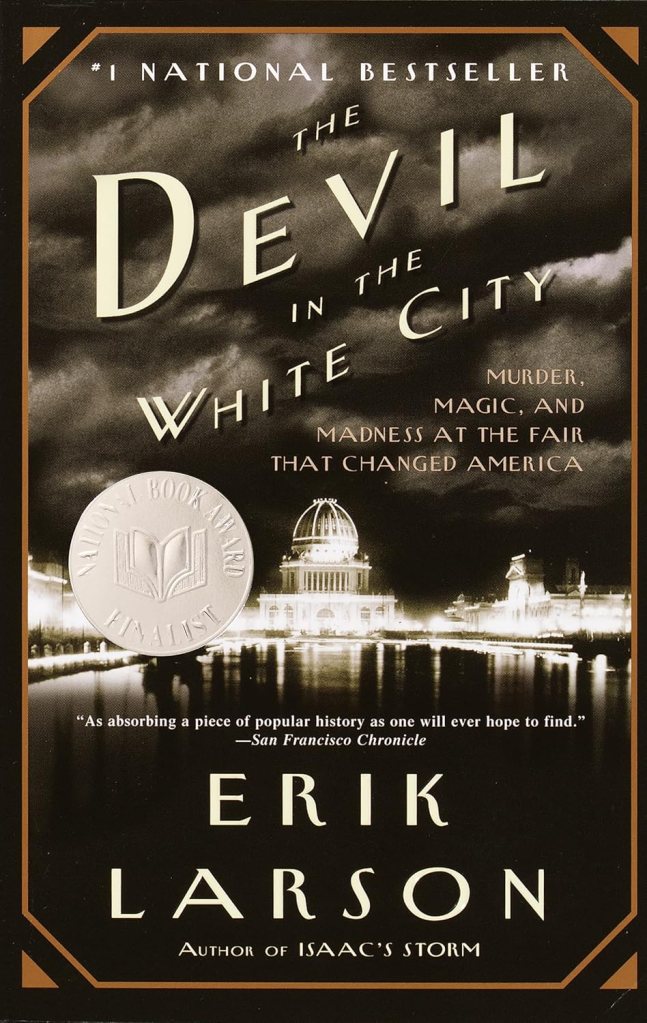
To be fair, the story of how the city of Chicago, at a time when it was made fun of by New York City for being known as merely a city of hog butchers, won the honor of hosting the prestigious event and actually made it happen despite so many setbacks is absolutely nothing short of a miracle. At a time when Paris was the talk of the world for having hosted its own fair and celebrated the completion of the Eiffel Tower, America needed to do something to top that event. It is against this backdrop that America’s most renowned architects came together and changed history forever. Again, this is a marvelous story, but for readers who are mainly interested in the true crime aspect of the story, it will be a sore disappointment as the story of the big fair and how it came to be takes up almost 70% to maybe even 80% of this huge book. As one reviewer aptly wrote, this story is more “City” and less “Devil”.
“Knowing me as you do, can you imagine me killing little and innocent children, especially without any motive?”
Herman Mudgett aka Dr. H.H. Holmes
When the story does shift to the psychopathic criminal Herman Mudgett, aka H. H. Holmes, it is certainly a frightening one. This takes place at a time when it seems as if the entire world is converging in Chicago for the fair, and when serial killers were not yet a recognized phenomenon. Holmes appears to have recognized this and took advantage not only of the lack of investigative skill in the police department but also of the fact that few would take notice of a few missing girls newly arrived in the city. Using his charm, wit, money, and good looks, our killer seemed to have easy pickings among whichever victims he chose, whether they were men, women, or even children.
“…the failure of the fair or anything short of a positive and pronounced success would be a discredit to the whole country, and not to Chicago alone.”
New York Times article
My suggestion? For readers interested only in the criminal portion of the story, they would likely do well to simply read the Wikipedia page of Dr. H. H. Holmes. For readers who find themselves having a hard time caring about the story of the fair at the beginning, I suggest having some patience and continuing on. I found that the story becomes much more exciting and thrilling once the men actually begin construction of the buildings. The many problems and pressure they had to face were enormous, and it is a tribute to their spirit that they soldiered on and continued pushing forward to make it happen and many times, at the cost to their own health. There are also some fun Easter eggs and interesting facts to learn along the way, such as how the Ferris wheel got its start, as well as how the big Chicago fair likely influenced none other than Walt Disney and his father. Although The Devil in the White City was not what I had expected going in, I am nonetheless happy that I stuck with it until the very end.






Leave a Reply